Skip to content
Utica Foundation

Serving Utica and nearby areas

House Settling in Utica, NY

A house that is settling unevenly in Utica usually has one footing sitting on softer or wetter soil, and a free inspection tells you whether it has stopped or is still sinking.

Book a free foundation inspection

Tell us what you are seeing. A local specialist calls you back the same business day.

Why basements leak and walls move in Utica

Utica sits in the Mohawk Valley on soils made from ground-up shale, with wetter clay soils in low spots. Winters bring about 100 inches of snow and dozens of freeze-thaw swings, and Sauquoit Creek and the Mohawk River flood often. About half the city's homes were built before 1940, so many basements are old stone, brick or block that has taken a century of wet springs.

  • Soil that changes across a lot

    USDA describes the main upland soil here as well drained, formed in firm till of soft black shale. Soils in low spots of the same family are poorly drained clay loam. A footing on the wetter soil can sink while the rest of the house stays put.

  • Footings below the frost

    Nearby Floyd lists a 48 inch frost line, and the Utica-Oneida County station averages about 59 freeze-thaw cycles a year. Porches, steps and additions on shallower footings can heave and drop with the frost.

  • Old houses, many add-ons

    About half of Utica's homes were built in 1939 or earlier, according to Census estimates. Many have had porches, kitchens and rooms added since, each on its own footing.

What it costs

Typical published ranges for Utica. The contractor's written estimate is the price, and the inspection is free.

WorkTypical range
Inspection and written estimate Free
Piers $1,000 to $3,000each
Most foundation repairs, national range $2,200 to $8,200
Underpinning a large section $10,000 to $40,000
Crack sealing or injection $200 to $1,000per crack
Structural engineer report $300 to $2,000

See typical foundation repair prices in Utica

What uneven settling looks like

Even settling is hard to see. The whole house drops a little and nothing cracks. Uneven settling is different. One part drops and the rest does not, and the house shows it.

One corner lower than the others

With floors sloping toward it

A stair-step crack

In the basement wall or outside brick, wider at the top

Doors on one side

That stick, rub at the top corner or will not latch

Windows that bind

Or have a wedge-shaped gap at the top

An addition or porch

Pulling away from the main house with a widening gap

Front steps

That have dropped or tipped away from the door

A chimney

Leaning away from the wall or with a gap where it meets the house

Cracks over doors and windows

Running at an angle toward the low corner

Why one part of a Utica house sinks

The soil is not the same under every footing

The soils around Utica formed from glacial till made of black shale. On higher ground, USDA describes them as well drained and firm. In low spots they turn into poorly drained clay that holds water. On many lots, the soil under the back of the house is not the same as the soil under the front. When the wetter part softens, the footing on it sinks.

Water changes the soil

A downspout that dumps at one corner, a yard that slopes toward one wall, or a leaking pipe can soak the soil under one footing for years. Wet clay is softer than dry clay. That is why settling so often shows up at the corner with the bad downspout.

Frost and shallow footings

The frost line nearby is listed at 48 inches, and the area sees about 59 freeze-thaw cycles a year. The main house on a full basement sits well below that. Porches, steps, sunrooms and older additions often do not. Their footings can heave up in winter and drop in spring, and over the years they settle out of line with the house.

Old houses with many add-ons

About half of Utica's homes were built before 1940. Many have had kitchens, porches and rooms added since, each built at a different time on its own footing. The joints between old and new are where settling shows first.

Normal or a problem?

Usually normal: thin, old cracks that do not grow; a house that has had the same slight lean for decades; doors that stick only in humid summer weather.

Worth checking soon: a crack that is wider at one end and growing; an addition with a gap that opened up in the last few years; doors that started sticking this year on one side.

Check it right away: a crack you can fit a coin in and growing; a chimney pulling away from the house; a porch or steps dropping fast; floors that tilted noticeably in one season.

How it is usually fixed

Fix the water

Downspouts, grading and any leaking pipes near the settled corner. Sometimes this alone stops slow settling.

Steel piers

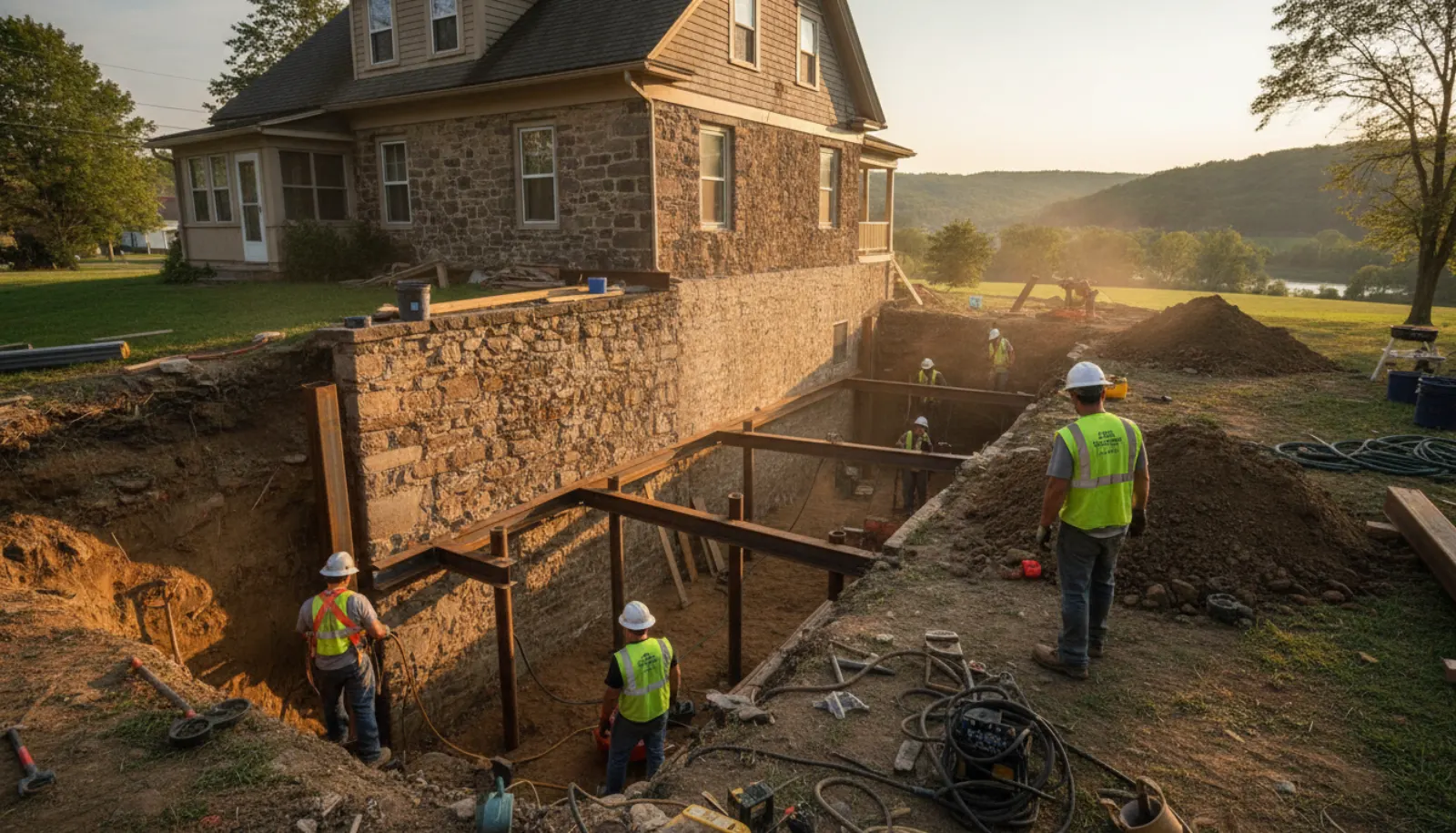
Piers are driven or screwed down under the footing until they reach firm soil or rock. The footing is then held on the piers, and can often be lifted a little.

Underpinning

For a long wall or a large section, new footing support is added under the old one along its length.

Rebuilding a porch or step footing

Shallow porch and step footings are often replaced with new ones set below the frost line.

Sealing the cracks

Once the movement is stopped, the cracks are sealed so water does not get in.

What it costs

Typical national ranges from published cost guides. Piers are priced each, and most settled corners need several. The Utica building department requires a permit for construction costing $1,000 or more, which covers nearly all pier work.

What to do before the inspection

  1. Pencil-mark and date the ends of each crack, inside and out.
  2. Note which doors and windows stick and on which side of the house.
  3. Walk around the outside in a hard rain and look for downspouts and low spots near the settled corner.
  4. Check whether any pipe runs under or near that corner and whether your water bill has jumped.
  5. Find out when any additions or porches were built, if you can.

Frequently asked questions

Is it normal for an old house to settle?

Yes. Every house settles some after it is built, mostly in the first few years. A Utica house built 100 years ago finished that long ago. New settling in an old house usually means something changed, most often water in the soil under one part of it.

How can I tell if my house is still settling?

Mark the ends of cracks with a pencil and date them, and check after each season. Watch for doors that stick more over time and gaps that grow. If nothing changes over a year, the movement may have stopped.

Why is my addition pulling away from the house?

Additions, porches and sunrooms are often built on shallower footings than the main house, and on soil that was dug and filled. They can settle or heave on their own. The joint between old and new is where the crack shows.

Can a settled house be lifted back to level?

Often part of the way. Steel piers can be driven to firmer soil and used to raise a settled corner slowly. An old house may not go all the way back without cracking plaster and windows, so the goal is usually to stop it and lift what is safe.

Does homeowners insurance cover settling?

It depends on your policy. Read the section on earth movement and ask your agent before the work starts. A written inspection report helps that conversation.

Can I cancel a foundation contract after I sign it?

Under New York law, a homeowner can cancel a home improvement contract until midnight of the third business day after signing, with a few exceptions for emergencies. Read the cancel notice in your contract.

Find out if it has stopped

Call (315) 322-9152 or send the short form. A local Utica crew will check every corner and give you a written price.

(315) 322-9152 Free inspection