Skip to content
Utica Foundation

Serving Utica and nearby areas

Bowing Basement Walls in Utica, NY

A bowing basement wall in Utica means wet, frozen soil is pushing it in, and a free inspection tells you how far it has moved and what it takes to stop it.

Book a free foundation inspection

Tell us what you are seeing. A local specialist calls you back the same business day.

Why basements leak and walls move in Utica

Utica sits in the Mohawk Valley on soils made from ground-up shale, with wetter clay soils in low spots. Winters bring about 100 inches of snow and dozens of freeze-thaw swings, and Sauquoit Creek and the Mohawk River flood often. About half the city's homes were built before 1940, so many basements are old stone, brick or block that has taken a century of wet springs.

  • Heavy clay in low spots

    USDA describes the wet soils of this Mohawk Valley family as poorly drained, with 28 to 35 percent clay in the subsoil and slow water movement below. That soil holds water right against the outside of the wall.

  • A push every winter

    The Utica-Oneida County station averages about 59 freeze-thaw cycles a year, and nearby Floyd lists a 48 inch frost line. Wet soil swells as it freezes, and the push lands on the upper half of the wall.

  • Old block, old mortar

    About half of Utica's homes were built in 1939 or earlier, according to Census estimates. Many block walls have held back wet soil for close to a century.

What it costs

Typical published ranges for Utica. The contractor's written estimate is the price, and the inspection is free.

WorkTypical range
Inspection and written estimate Free
Carbon fiber straps, whole wall job $4,000 to $12,000
Wall anchors, eachAngi lists $400 to $700, Fixr $1,500 to $2,000 $400 to $2,000
Wall anchors, typical project $5,000 to $15,000
Bowing wall repair, whole job $4,000 to $15,000
Structural engineer report $300 to $2,000

See typical foundation repair prices in Utica

What a bowing wall looks like

A bowing wall bends in toward the basement. It rarely happens all at once. Most people notice one small thing first, then see the rest once they start looking.

A long sideways crack

Running along a mortar joint, often about halfway up the wall

A belly in the middle

Of the wall when you sight along it from one end

A wall that leans in at the top

Where it meets the wood sill

Blocks at the bottom that have slid in

Past the row above them

Stair-step cracks at the corners

Where the bowing wall meets a side wall

Gaps at the top of the wall

Or a sill plate that no longer sits flat

Water or white powder along the crack

Showing where the soil is wettest

The most common place to find it in Utica is a concrete block wall on the long side of the house, often the side with a downspout or the side the yard slopes toward.

Why walls bow here

Wet soil is heavy

The soil around Utica formed from glacial till made of ground-up shale. On hills and slopes it drains well. In low spots and on flat lots, it turns into a poorly drained clay that holds water for weeks. Wet soil weighs more than dry soil, and it presses hard on anything holding it back.

Frost pushes from the outside

The area sees about 59 freeze-thaw swings in an average winter. When wet soil next to the wall freezes, it swells. The ground below the frost line does not move, so the push lands on the upper part of the wall. When the soil thaws, it settles, but the wall does not spring back. Each winter adds a little more.

Snowmelt keeps it soaked

With about 100 inches of snow in a normal year, the ground next to the house stays wet for weeks each spring. That is when many people first see the crack, and when walls move the most.

Block walls bend at the joints

A hollow concrete block wall is strong when you press straight down on it. It is weak when you push on its side. The mortar joints act like hinges. That is why the long crack shows up along a joint, and why block walls bow far more often than poured concrete walls.

Cosmetic or urgent?

Watch it if the wall has a thin sideways crack and you cannot see any bend when you sight along it. Mark the crack ends and date them. Fix the gutters and grading now.

Book an inspection soon if you can see a bend, the crack is wider than a pencil line, or there is water along it.

Get it checked right away if the bottom of the wall has slid in, blocks are pushing out of line, the bend grew over one winter, or upstairs doors suddenly stick on that side of the house.

How it is usually fixed

The right fix depends on how far the wall has moved and what is on the other side of it.

Carbon fiber straps

Glue to the wall every few feet and stop more movement. They are thin and work best on walls that have moved only a little.

Wall anchors

Run through the wall to a plate buried in the yard. They hold the wall and can sometimes be tightened to bring it back a bit over time. They need clear yard space on that side.

Steel beams

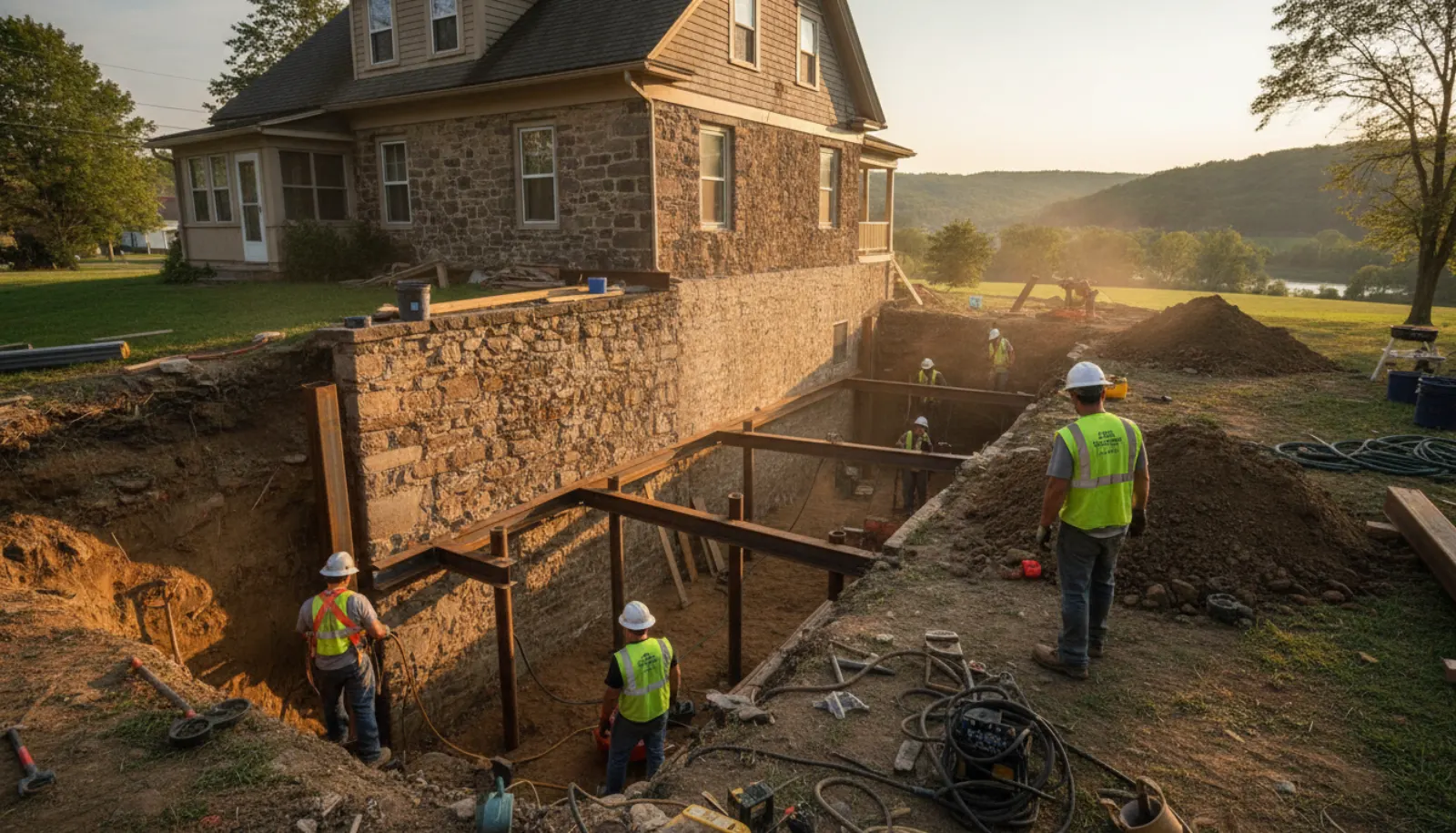
Stand against the wall from floor to ceiling joists. They work where the yard has no room for anchors, such as next to a driveway or a neighbor's house.

Rebuilding the wall

Is for walls that have moved too far to brace. The crew digs out that side, takes the wall down, and builds it back with drainage.

Almost every fix in Utica should come with a water plan too: gutters, downspouts carried away from the wall, and grading that slopes away. Less water in the soil means less weight and less frost push.

What it costs

Prices below are typical national ranges from published cost guides. Your written estimate depends on the wall length, how far it has moved, yard access and whether drainage work is included.

What to do before the inspection

  1. Sight along the wall from one end and take a photo from the same spot.
  2. Pencil-mark the ends of each crack and write the date.
  3. If you have a long level or a tight string, measure how far the middle sits from straight.
  4. Note when water shows up: rain, snowmelt or all the time.
  5. Clear boxes and shelves away from the wall so the inspector can see it.
  6. Look outside on that side for downspouts dumping near the wall and soil sloping toward the house.

Bring your notes and photos to the free inspection. They show how fast the wall is moving, which is the most useful thing the inspector can know.

Frequently asked questions

How much bowing is too much?

There is no single number that fits every wall. What matters is how far it has moved, whether the bottom has slid, and whether it is still moving. A wall that has moved a little can often be braced where it stands. A wall that has moved a lot, or keeps moving, may need more. Measure it now so the inspector can compare.

Can a bowing wall be pushed back straight?

Sometimes, a little. Wall anchors can be tightened over time to draw some walls back as the soil allows, usually in dry months. Straps and beams hold a wall where it is. A wall that has moved too far may need to be rebuilt.

Will my basement wall collapse?

Most bowing walls move slowly over years, not overnight. But a wall that is sliding at the bottom, has blocks pushed in, or is moving fast after a wet spring should be checked right away.

Do I need a permit to fix a bowing wall in Utica?

The City of Utica requires a building permit for construction costing $1,000 or more, and nearly every wall repair costs more than that. The contractor usually pulls it.

Is it safe to sell a house with a bowing wall?

You can, but buyers' inspectors look for it and lenders may ask questions. A repair with a written, transferable warranty often makes the sale easier than a price cut.

Does fixing the gutters stop a wall from bowing?

It helps a lot, because less water means less pressure and less frost push. On its own it rarely fixes a wall that has already moved. Drainage and bracing usually go together.

Get the wall checked

Call (315) 322-9152 or send the short form. A local Utica crew will look at the wall, measure it, and give you a written price.

(315) 322-9152 Free inspection